Natural Stone Paver Driveway Cost: A Detailed Planning Guide
A Comprehensive Guide to Natural Stone Paver Driveways
Natural stone pavers represent one of the most durable and aesthetically sophisticated options for residential driveways. Unlike poured concrete or asphalt, natural stone is harvested from the earth, resulting in unique variations in color, texture, and mineral composition. Beyond their visual appeal, these materials are prized for their compressive strength and ability to withstand the heavy vehicular loads associated with daily residential use.
This guide provides an objective, educational analysis of the factors that influence natural stone paver driveway cost. Readers will explore the different types of stone available, the technical requirements of a stable installation, and the long-term maintenance considerations that define the total cost of ownership. By understanding the geological properties of the materials and the engineering required for the base layers, property owners can make informed decisions regarding their exterior infrastructure.

Understanding Natural Stone Paver Driveway Cost
The core concept of a stone paver driveway is the “interlocking” system. While the stones themselves are rigid, the system as a whole is flexible, allowing it to shift slightly with temperature changes and soil movement without cracking. Most property owners approach this project with the goal of achieving a “lifetime” driveway that requires minimal structural repair compared to asphalt.
When evaluating natural stone paver driveway cost, it is important to distinguish between material prices and installation labor. Stone is significantly heavier than concrete pavers, increasing shipping costs and requiring more intensive manual labor for cutting and fitting. A typical outcome of a well-executed stone driveway is a permeable or semi-permeable surface that manages water runoff effectively while providing a high-friction surface for vehicles. Expectations should be set around a higher initial investment in exchange for a significantly longer service life and reduced replacement frequency.
Key Categories of Natural Stone Materials
The type of stone selected is the primary driver of both the aesthetic and the budget. Stones are categorized by their mineral density and the ease with which they can be quarried and shaped.
| Category / Type | Description | Common Use Case | Time / Cost / Effort Level |
| Granite | An igneous rock with extreme hardness and slip resistance. | High-traffic areas; cold climates with freeze-thaw cycles. | High / Premium |
| Cobblestone | Small, rounded or “tumbled” stones (often granite or basalt). | Historic or traditional European-style aesthetics. | Very High / Premium |
| Travertine | A form of limestone deposited by mineral springs; porous. | Warm climates; luxury Mediterranean-style homes. | Moderate / Mid-Range |
| Sandstone | A sedimentary rock with rich, earthy tones and textures. | Rustic designs; areas requiring high water permeability. | Moderate / Economical |
| Slate | A metamorphic rock that can be “split” into flat layers. | Modern, sleek designs; typically used in lower-traffic areas. | Moderate / Mid-Range |
Choosing between these materials involves balancing regional availability with climate demands. For example, porous stones like travertine may require specialized sealing in regions with heavy winter salting, whereas granite remains largely unaffected by chemical de-icers.
Practical Scenarios for Stone Driveways
Scenario 1: The High-Load Entryway
For properties that frequently host heavy SUVs or delivery trucks, the driveway must prioritize compressive strength.
-
Components: 3-inch thick granite pavers, a 12-inch compacted crushed stone base, and polymeric sand joints.
-
Process: Deep excavation is followed by multiple layers of mechanical compaction to prevent “rutting” or sinking under the weight of tires.
-
Relevance: This scenario maximizes the natural stone paver driveway cost but ensures the structure does not fail under heavy mechanical stress.
Scenario 2: The Historic Preservation Project
Homeowners in historic districts often use cobblestones to maintain the architectural integrity of a 19th-century aesthetic.
-
Components: Belgian blocks, a mortar or sand bed, and hand-fitted edge restraints.
-
Process: Stones are hand-set in a “fan” or “running bond” pattern, often requiring a master mason to ensure the irregular shapes fit tightly.
-
Relevance: This use-case focuses on craftsmanship and heritage value over modern installation speed.
Scenario 3: The Sustainable Permeable Driveway
In municipalities with strict runoff regulations, stone driveways can be engineered to allow water to filter back into the ground.
-
Components: Wide-joint sandstone pavers and an open-graded aggregate base (no “fines” or dust).
-
Process: Instead of tight sand joints, larger pebbles or “chips” are used between stones to facilitate high-volume drainage.
-
Relevance: This prevents local drainage systems from being overwhelmed during heavy rain events and can sometimes reduce municipal “impervious surface” taxes.
Comparison: Scenario 1 focuses on structural utility; Scenario 2 on aesthetic and historical accuracy; Scenario 3 on environmental compliance. Readers should choose the scenario that aligns with their local building codes and vehicle usage patterns.
Planning, Budgeting, and Resource Considerations
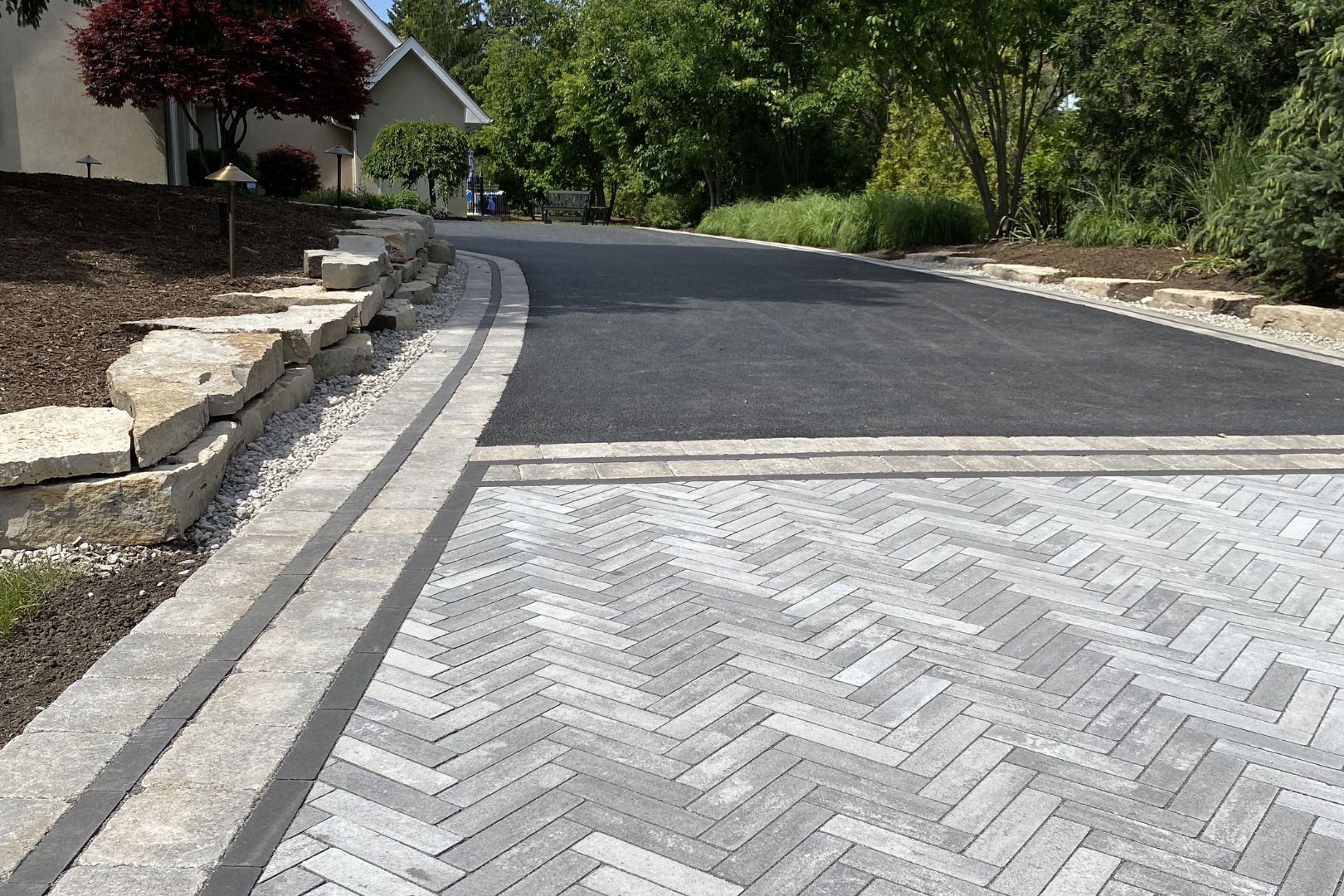
Meticulous planning is required because stone pavers cannot be easily “patched” if the dimensions are off. Preparation involves calculating the “tonnage” of the stone and ensuring the delivery site can handle heavy pallets.
| Category | Estimated Amount (Example) | Explanation | Optimization Tips |
| Materials (Stone) | $15 – $40 per sq ft | The raw cost of the stone pavers. | Source stone from local quarries to reduce shipping fees. |
| Base Aggregates | $2 – $5 per sq ft | Crushed stone and sand for the foundation. | Use recycled concrete as a base layer if code allows. |
| Labor (Pro) | $10 – $30 per sq ft | Specialized cutting and manual setting. | Simplified patterns (e.g., Running Bond) reduce labor hours. |
| Excavation/Hauling | $1,000 – $3,000 | Removing old asphalt and soil. | Reuse excavated soil elsewhere on the property for landscaping. |
Note: These figures are illustrative examples. Total natural stone paver driveway cost can fluctuate based on the “thickness” of the pavers (e.g., 2-inch vs. 3-inch) and the complexity of the site’s slope.
Strategies, Tools, and Support Options
Evaluating the support methods for a stone driveway is critical for preventing shifting over time.
-
Polymeric Sand: A high-tech sand mixed with additives that harden when wet.
-
Pros: Prevents weed growth and ant hills; locks pavers in place.
-
Cons: Requires a completely dry installation window; more expensive than play sand.
-
-
Mechanical Compaction: Using a heavy vibrating plate compactor.
-
Pros: Eliminates air pockets in the base; prevents future sinking.
-
Cons: Requires specialized equipment; can crack thin stones if used without a protective mat.
-
-
Geotextile Fabrics: A “separation layer” placed between the soil and the stone base.
-
Pros: Prevents the stone base from sinking into soft clay or mud.
-
Cons: Adds an extra step to the excavation process.
-
-
Edge Restraints: Plastic, metal, or concrete barriers at the driveway’s perimeter.
-
Pros: Prevents the “creeping” or spreading of pavers toward the lawn.
-
Cons: Must be anchored deeply with spikes to survive frost heaves.
-
Safety, Risks, and Common Challenges
-
Poor Drainage: If the driveway is not pitched (sloped) at least 2% away from the home, water will pool against the foundation. Mitigation: Use a transit level during the base-layer installation to ensure a consistent slope.
-
Under-Compaction: If the base is not compacted in 2-inch “lifts” or layers, the driveway will develop ruts within the first year. Prevention: Verify that the contractor is using a compactor rated for the depth of the project.
-
Surface Slippage: Some stones (like polished slate) become dangerously slick when wet. Prevention: Opt for “flamed,” “honed,” or “natural cleft” finishes that provide mechanical grip.
-
Salt Damage: Certain soft limestones can be dissolved or pitted by road salt. Action: Only use granite or basalt in regions where salt is used, or apply a high-quality penetrative sealer.
Maintenance and Long-Term Management
While natural stone is incredibly durable, it requires periodic management to maintain its structural and aesthetic properties.
-
Joint Refilling: Every 3–5 years, the sand in the joints may wash away. Re-sweep with polymeric sand to maintain the interlocking bond.
-
Cleaning: Use a pH-neutral stone cleaner and a soft-bristle brush once a year to remove organic growth like moss or algae. Note: Avoid high-pressure washers, which can dislodge joint sand or etch softer stones.
-
Sealant Re-application: If using a sealer for color enhancement or stain protection, it generally needs to be reapplied every 2–4 years.
-
Snow Removal: Use plastic-edged shovels or snow blowers with the skids set high to prevent scratching the stone surface.
Documentation and Reporting
Organizing the records of a stone driveway project is essential for future property valuations and repairs.
-
The Project Portfolio: Store the original quote, the name of the stone quarry, and the specific color name/batch number.
-
Example 1: A homeowner retains a “surplus” pallet of 20 pavers. Ten years later, after a utility line repair, they use these original stones to patch the driveway, ensuring a perfect color match.
-
Example 2: An owner documents the “permeability rating” of their sandstone driveway, which they provide to the local municipality to qualify for a stormwater management credit on their property taxes.
Closing Summary
The natural stone paver driveway cost reflects an investment in geology and engineering. By selecting high-density stones like granite or basalt and ensuring a meticulously compacted, well-drained base, property owners can secure a functional and prestigious infrastructure element that outlasts traditional paving materials by decades.